

Overview
Workflows > Logs > Tab OVERVIEW
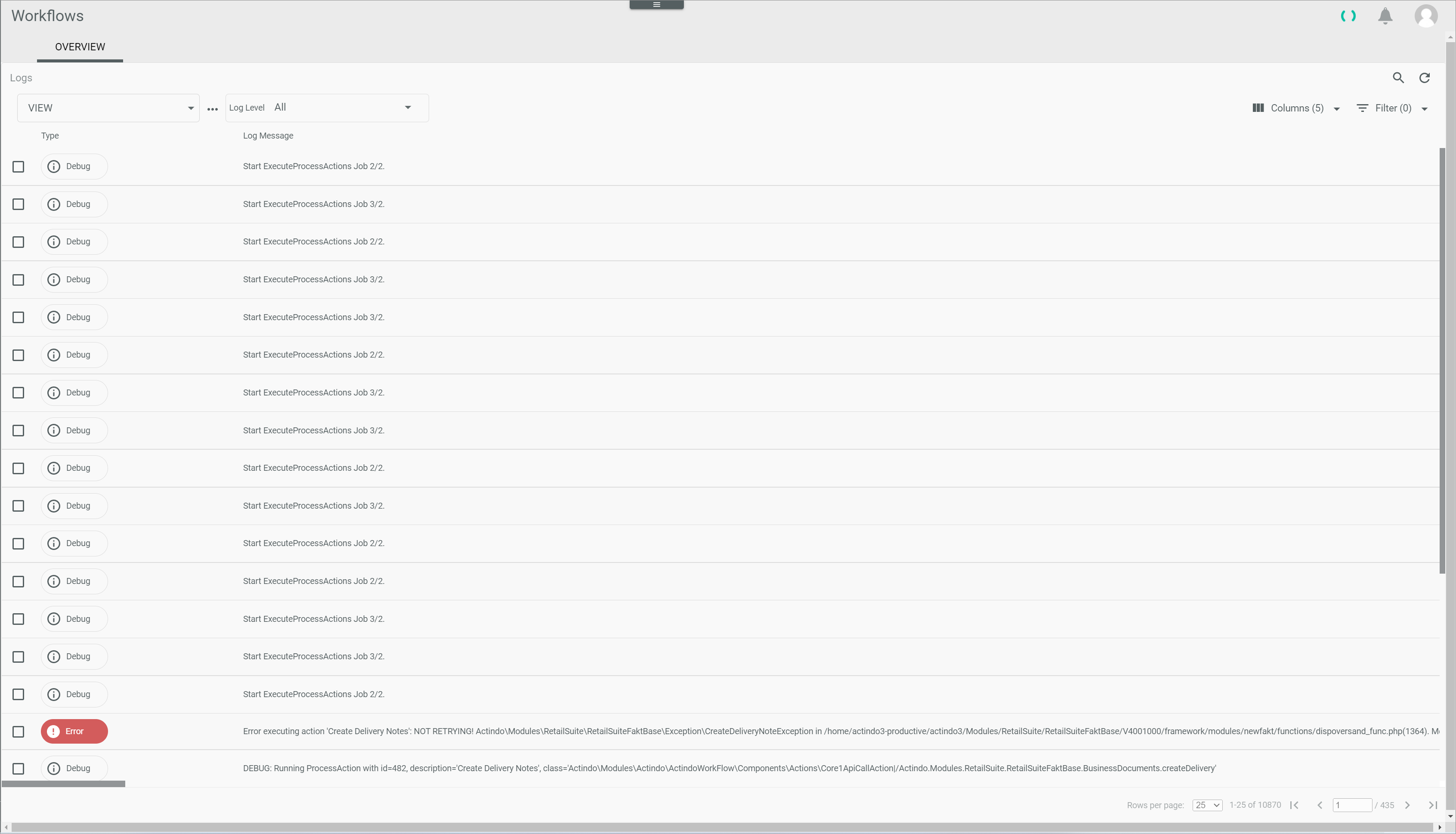
Logs
-
VIEW
Click the drop-down list to select the view. All created views are displayed in the drop-down list. Click the (Points) button to the right of the VIEW drop-down list to display the context menu and create a view.
 -
(Points)
Click this button to the right of the View drop-down list to display the context menu. The following menu entries are available:-
 create
Click this entry to create a view. The Create view window is displayed, see Create view. -
 rename
Click this entry to rename the selected view. The Rename view window is displayed, see Rename view. This menu entry is only displayed if a view has been selected. -
 reset
reset
Click this entry to reset all unsaved changes to the settings of the selected view. This menu entry is only displayed if a view has been selected and any changes have been made to the view settings. -
 publish
Click this entry to publish the view. This menu entry is only displayed if a view has been selected and unpublished. -
 unpublish
Click this entry to unpublish the view. This menu entry is only displayed if a view has been selected and published. -
 save
save
Click this entry to save the current view settings in the selected view. This menu entry is only displayed if a view has been selected.When the settings of a view have been changed, an asterisk is displayed next to the view name. The asterisk is hidden as soon as the changes have been saved.
 delete
Click this entry to delete the selected view. A confirmation window to confirm the deletion is displayed. This menu entry is only displayed if a view has been selected.
-
-
-
Log level
Click the drop-down list to select a log level. The following options are available:- All
Select this option to display all logs regardless of their level. - Debug
Select this option to display all logs with Debug level. - Info
Select this option to display all logs with Info level. - Notice
Select this option to display all logs with Notice level. - Warning
Select this option to display all logs with Warning level. - Error
Select this option to display all logs with Error level. - Critical
Select this option to display all logs with Critical level. - Alert
Select this option to display all logs with Alert level. - Emergency
Select this option to display all logs with Emergency level.
- All
-
 (Search)
Click this button to display the search bar and search for a log. -
 (Refresh)
Click this button to update the list of logs. -
 Columns (x)
Click this button to display the columns bar and customize the displayed columns and the order of columns in the list. The x indicates the number of columns that are currently displayed in the list.  Filter (x)
Click this button to display the filter bar and customize the active filters. The x indicates the number of filters that are currently active.
The list displays all logs that are matching the selected log level. Depending on the settings, the displayed columns may vary. All fields are read-only. Click a log to display the Log ID view, see Log ID.
-
Type
Log level. The following levels can be displayed:- Debug
- Info
- Notice
- Warning
- Error
- Critical
- Alert
- Emergency
-
Log message
Description of the issue. -
Workflow
Workflow which the log message refers to. -
Workflow ID
Workflow identification number. The ID number is automatically assigned by the system. -
Created
Date and time of creation. -
ID
Log identification number. The ID number is automatically assigned by the system. -
Process
Description of the process to which the log refers. -
Process ID
Identification number of the process to which the log refers. The ID number is automatically assigned by the system. -
Transition
Key of the transitions to which the log refers. -
Transition ID
Identification number of the transition to which the log refers. The ID number is automatically assigned by the system. - Created by
Name and user name of the user who initiated the process.
Log ID
Workflows > Logs > Tab OVERVIEW > Select Log message
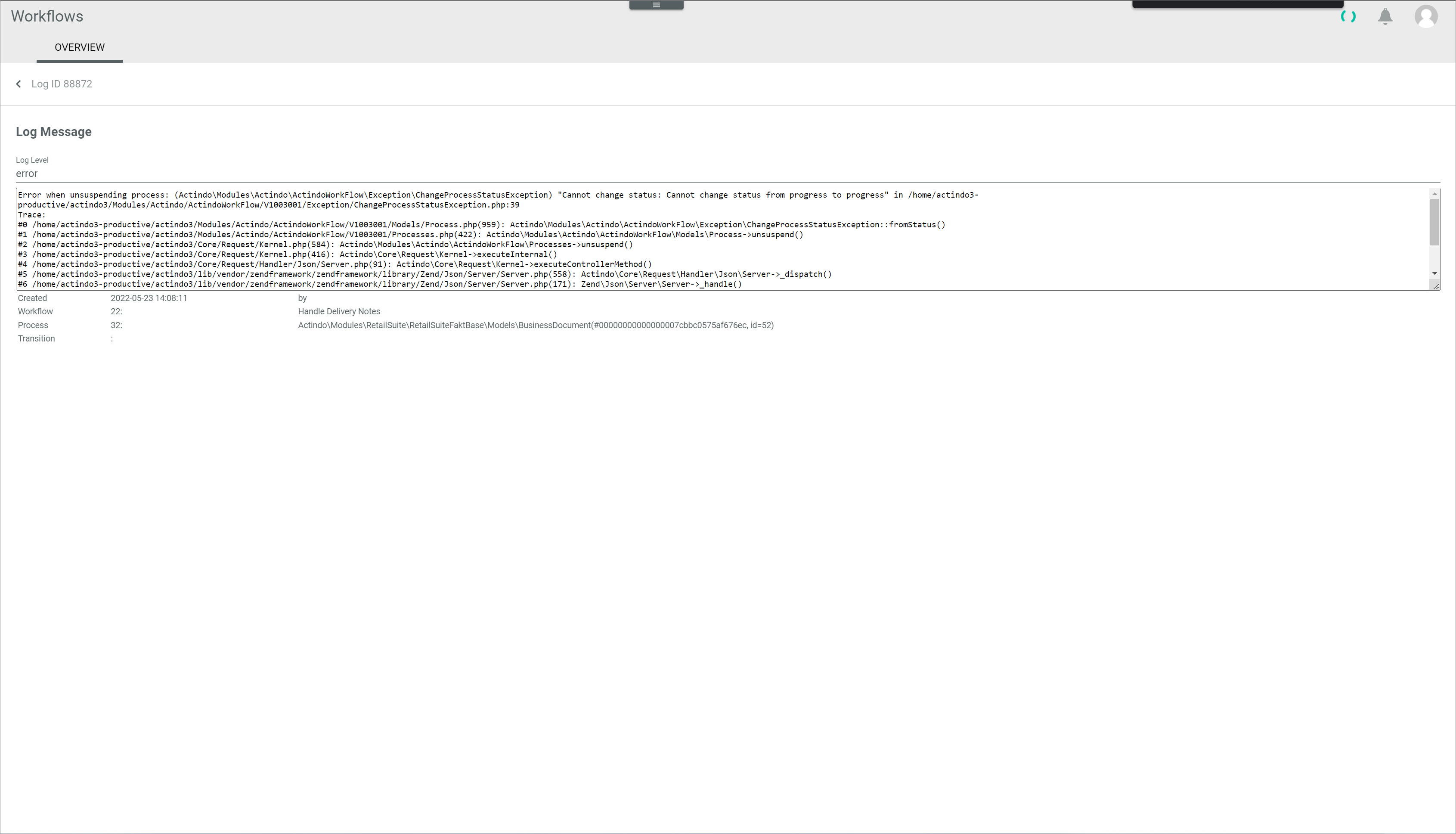
 (Back)
Click this button to close the Log ID view and return to the Logs tab. All changes are rejected.
Log message
In the Log message section, detailed information about the log is displayed. All fields are read-only.
-
Log level
Log level type. The following levels are available:- Debug
- Info
- Notice
- Warning
- Error
- Critical
- Alert
- Emergency
-
Log message box
Detailed log message with further information.In case of an error, detailed information is provided (stack trace) for reporting and debugging purposes.
-
Created - by
Date and time of creation, name and user name of the user who initiated the process. -
Workflow
Workflow ID number and name. -
Process
Process ID number and description. - Transition
Transition ID number and description.
This window can also be accessed from the OVERVIEW (Processes) tab in the user interface.
Create view
Workflows > Logs > Tab OVERVIEW > Button Points > Menu entry create
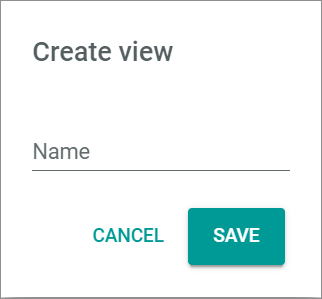
For a detailed description of this window and the corresponding functions, see Create view.
Rename view
Workflows > Logs > Tab OVERVIEW > Button Points > Menu entry rename
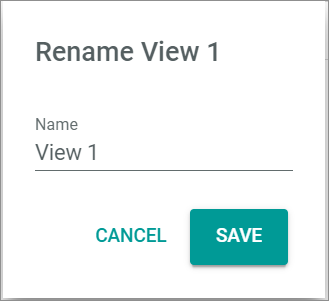
For a detailed description of this window and the corresponding functions, see Rename view.